


Freeing Hope from Our Egos
- Rev. Richard Belous

- Feb 9
- 4 min read
As we start a New Year, a leading U.S. psychologist and podcaster suggests that there is a better way of looking at hope than many Americans are currently following.
Dr. David DeSteno is a professor of psychology at Northeastern University and the host of an interesting podcast entitled: “How God Works: The Science Behind Spirituality.”
He notes that currently hope is in the dumpster for many Americans. Several leading surveys have reported that the vast majority of Americans currently believe that things will not be as good for their children as they have been in the past for them. This is a big switch since Americans have tended to believe that their children would ‘have it better’ than the current adult generation.
Also, many leading opinion surveys have documented that a majority of Americans now believe that the U.S. will be economically weaker and more polarized in the coming years. Meanwhile, more than half of us don’t believe that we will be able to make positive advances in several key global challenge areas, such as global warming.
In a recent New York Times column, Dr. DeSteno says that, “This lack of hope is ominous. Hope drives us to improve our lives and the world around us. When it’s extinguished, despair and paralysis fill the gap, making progress even less likely.”
He believes that part of the reason why hope has headed south is because the modern notion of what hope is all about is flawed. “In the modern view, hoping for something implies that you think it is achievable,” Dr. DeSteno explains. Specifically this version of hope centers on the ability of the ego to solve the problem or get the metaphysical ‘football’ into the end zone for a touchdown.
However, time-and-time-again our frail and flimsy egos can’t do the job and just wind up fumbling the ball on the other team’s 5 yard line. “From the modern perspective, the solution is obvious: Dial back your hopes,” he points out. However, the problem with this is that the baby often gets thrown out with the bathwater, and that is what Dr. DeSteno believes we are seeing.
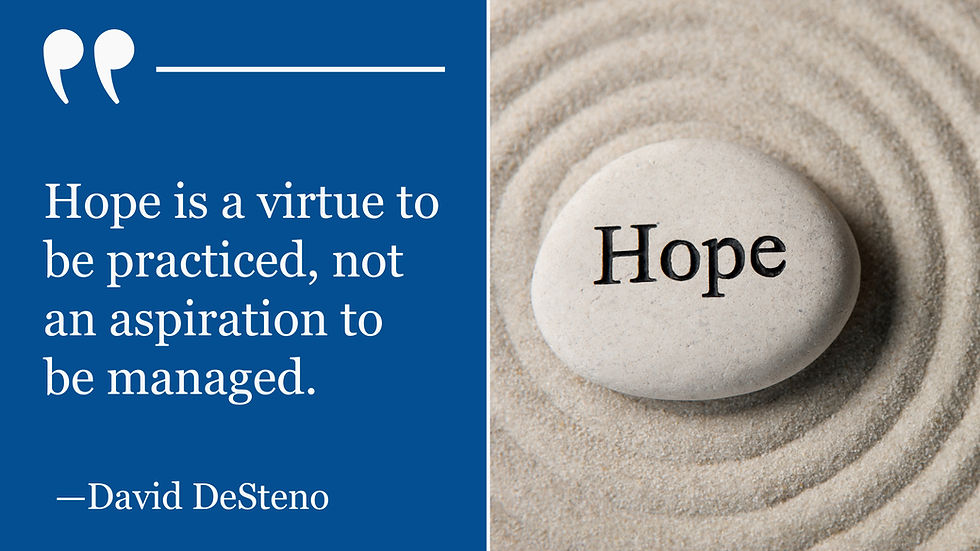
“Fortunately, an alternative conception of hope exists, one that throughout history has helped ward off despair and motivate action even in the face of seemingly insurmountable challenges. It’s an idea the world’s spiritual traditions have championed for millenniums: Hope is a virtue to be practiced, not an aspiration to be managed,” he asserts.
In other words, we are called by God/an Enlightened Master/A Way or a Path/Our Higher Self/or A Perennial Philosophy (as Aldus Huxley put it) to do certain things. Our hope is in the long run nature of the “call” and not in the short run nature of the “goodies” generated. We are doing “X” because it is the right thing to do.
Dr. DeSteno gives a wide range of spiritual giants from Saint Thomas Aquinas to the Buddhist scholars, to Talmudic rabbis who have advanced this notion of hope. On top of this he cites several studies that indicate that people who are in line with this broadly based spiritual concept of hope are more likely to be making charitable contributions, volunteering for nonprofits, and feeling more peace and joy in their lives than folks who are not.
The Northeastern University psychology professor is very much in line with the research and beliefs of one of my “sheroes,” Dr. Jane Goodall, who recently made her transition. The last book of hers published before her death was entitled: The Book of Hope. Similar to Dr. DeSteno, Dr. Goodall believed in a broadly based spiritual notion of hope. We are “called” to follow a path which is not based on short run results. We should be doing things because they are the right things to do.
Also, similar to Dr. DeSteno, Dr. Goodall felt there were sound scientific reasons backing up this notion of hope. For example, Dr. Goodall pointed to many ecological systems, such as jungles and rainforests, that show a remarkable ability to grow back to health if they are given half a chance.
She also pointed to the attitudes and values of millions of young people around the world. Dr Goodall also was the founder of the “Roots and Shoots” movement, which includes youth clubs from around the world doing ecologically based projects. She noted that whenever she needed to recharge her hope batteries, she would go spend time with young people.
Rabbi Angela Buchdahl currently serves as the senior rabbi of the Central Synagogue in New York City, which is one of the largest and most visible Reform congregations in the United States.
Dr. DeSteno notes the following: “Religion at its best, as Rabbi Angela Buchdahl once told me, serves as a constant reminder that life is not about any one of us. We’re all part of something bigger. The same is true for hope. Freeing hope from our egos frees us from despair. To hope is to do good without expectation that we can make it so. It is to resist the darkness daily whatever may come.”
May you be filled with hope whatever may come.
Many blessings,
Rev. Rick


