The Courage to Pray

Updated: Aug 12
Recently, as part of the Spiritual Life Center’s new series on Unity & World Religions, roughly fifty of us made a “field trip” to a conservative Jewish synagogue.
Rabbi Ben Herman, the senior spiritual leader at the Mosaic Law Congregation of Sacramento, was our wonderful tour guide — and what a tour it was!
First, it was an interesting process getting into the synagogue. Because of rising antisemitic violence (which has been as close as Carmichael) the temple is surrounded by a large wall and gate. Often there is an armed guard. We had to give the synagogue a detailed list of everybody who was going to be there from SLC. I was sad that such a thing is necessary in America, but unfortunately these precautions are needed at many Jewish institutions.
Second, Rabbi Herman took us into the sanctuary, which was beyond fascinating. There was the Ark, which contained Torah scrolls. SLC members asked Rabbi Herman very interesting questions and the Rabbi answered them with such knowledge and often humor.
View some photos taken by field trip attendee and SLC volunteer, RJ Bullen, on the trip:
After visiting the sanctuary, Rabbi Herman took us to their smaller chapel. There he showed us Jewish “phylacteries” and “tefillin,” which are often used by Jews around the world in their morning prayers.
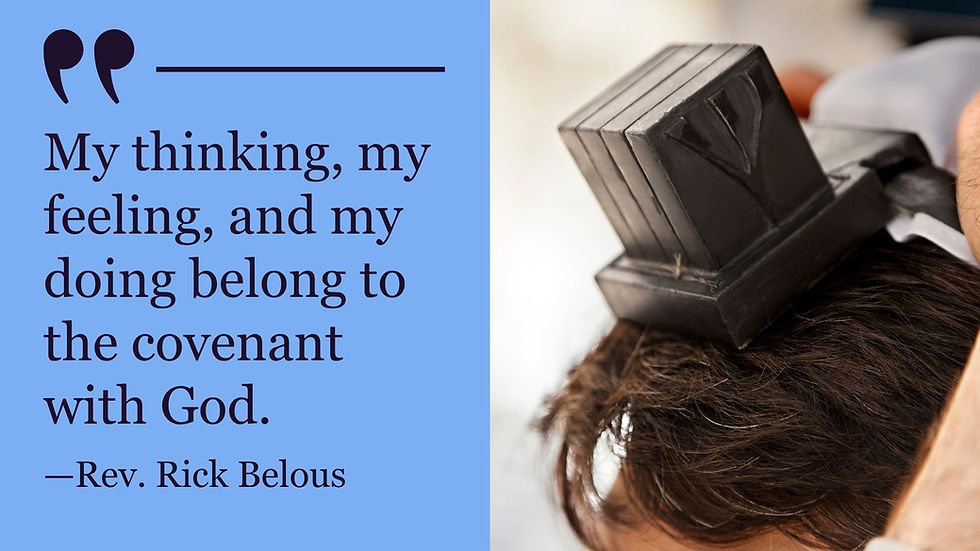
In Jewish practice, “phylacteries” are the small black leather boxes containing Torah passages. They are bound on the arm and the forehead during certain prayers, as a reminder of the covenant with God and the sacred laws.
Tefillin are two cube-shaped leather boxes which contain key verses from the sixth chapter of Deuteronomy (“You shall love the Lord your God with all your heart, with all your soul, and with all of your might.”) Jesus pointed to these words as the “greatest commandment.”
This prayer practice enacts the biblical commands to place God’s teaching “as a sign upon your hand” and “as frontlets between your eyes,” turning the covenant with God into a physical, daily practice.
The older term “phylactery” touches on the sense of protection, and viewing these objects as guarding the wearer spiritually by keeping divine words literally close.
While Jewish thought is wary of magical readings, there is still a strong sense that living within the discipline of tefillin places one under the shelter of Torah and the God who gave it.
One way to visualize the symbolism is as follows: each morning the worshiper places Torah at the “axis points” of self — mind and heart/strength — so that everything that follows in the day is carried out under the sign of deliverance, God’s commands, and love. The act becomes a liturgical rehearsal of saying, “My thinking, my feeling, and my doing belong to the covenant with God.”
Needless to say we SLCers were very interested in all of this. I then asked Rabbi Herman if I could tell a short story, and he said yes. Let me also tell this story to you:
It was back in the 1980s, and I was very new to Unity. I was on an airplane in the middle seat with people to the left and right of me. For some reason, I was too embarrassed to open up my Daily Word or copies of other Unity literature. “What if people see me reading this stuff, and they want to get into a discussion with me about it,” I asked myself. So I kept all of this Unity writing in my briefcase.
But after the airplane took off and leveled at cruising altitude, several Orthodox Jews asked the stewardess if it would be okay for them to pray in the aisle of a plane. The flight attendant said yes.
So these Orthodox gentlemen proceeded to put on their phylacteries and tefillin and prayed. They were not embarrassed to do so, and it didn’t matter to them if other people on the plane had negative thoughts about them doing this.
In fact, I think most of the people on the airplane were really interested in what they were seeing. After the prayers were finished many people asked a lot of interesting questions.
My reaction was one of deep respect for what these Orthodox Jews were doing. I felt a new sense of courage to pray in public, and to see it with joy if somebody asked me about the Daily Word or about my copy of Discover the Power Within You by that great Unity teacher, Eric Butterworth.
I think the BIG BOOK of Alcoholics Anonymous (which is considered to be the central text of AA) really hits the nail on the head about all this when it says the following:
“We never apologized to anyone for depending upon our Creator. We can laugh at those who think spirituality is the way of weakness. Paradoxically, it is the way of strength. The verdict of the ages is that faith means courage. All men of faith have courage. They trust their God. We never apologize for God. Instead we let Him demonstrate, through us, what He can do. We ask Him to remove our fear and direct our attention to what He would have us be. At once, we commence to outgrow fear.”
To this I say, “Amen and amen!”
Many blessings,
Rev. Rick Belous